
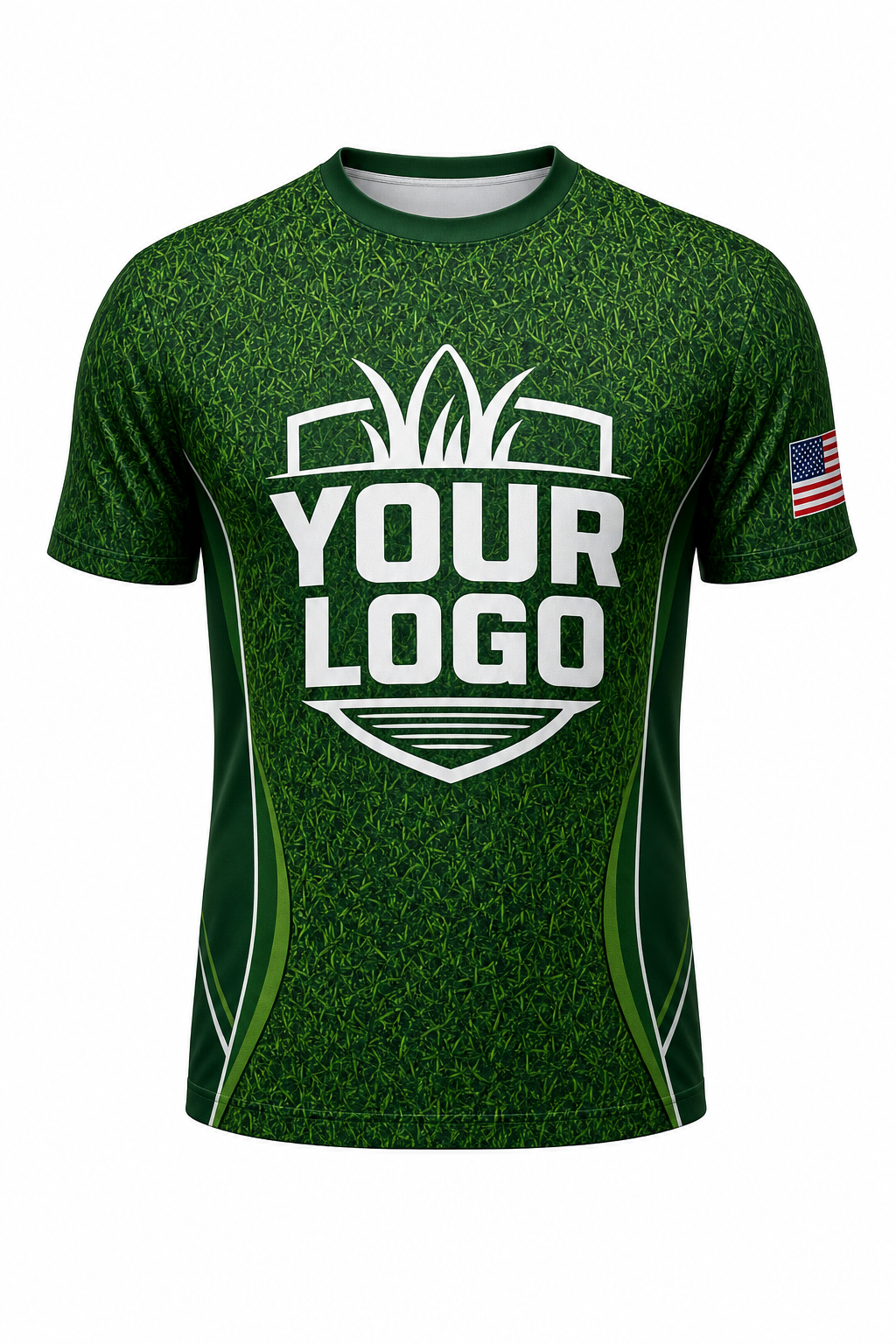
By ten in the morning in July, the guy on the trimmer has already sweat through his shirt, and by August the crew tees you bought in spring are faded and stained green at the hip. A lawn route is one of the hardest environments a work shirt can live in: full sun for eight hours, constant sweat, grass and red-clay stains, fertilizer dust, fuel splashes, and a wash routine aggressive enough to deal with all of it. This guide covers what actually holds up — fabric, print method, layout, sizing, care, and how to get a matched set on your crew without a big upfront order.
Heat Comes First: Pick the Fabric Before the Design
A cotton tee feels fine at 7 a.m. By noon it has soaked up a pound of sweat, gone heavy and clammy, and started chafing wherever the trimmer strap sits. Moisture-wicking polyester works differently: the fiber doesn't absorb sweat, it moves it to the surface where it evaporates. The shirt stays light, dries between properties, and doesn't cling when you climb back into the truck.
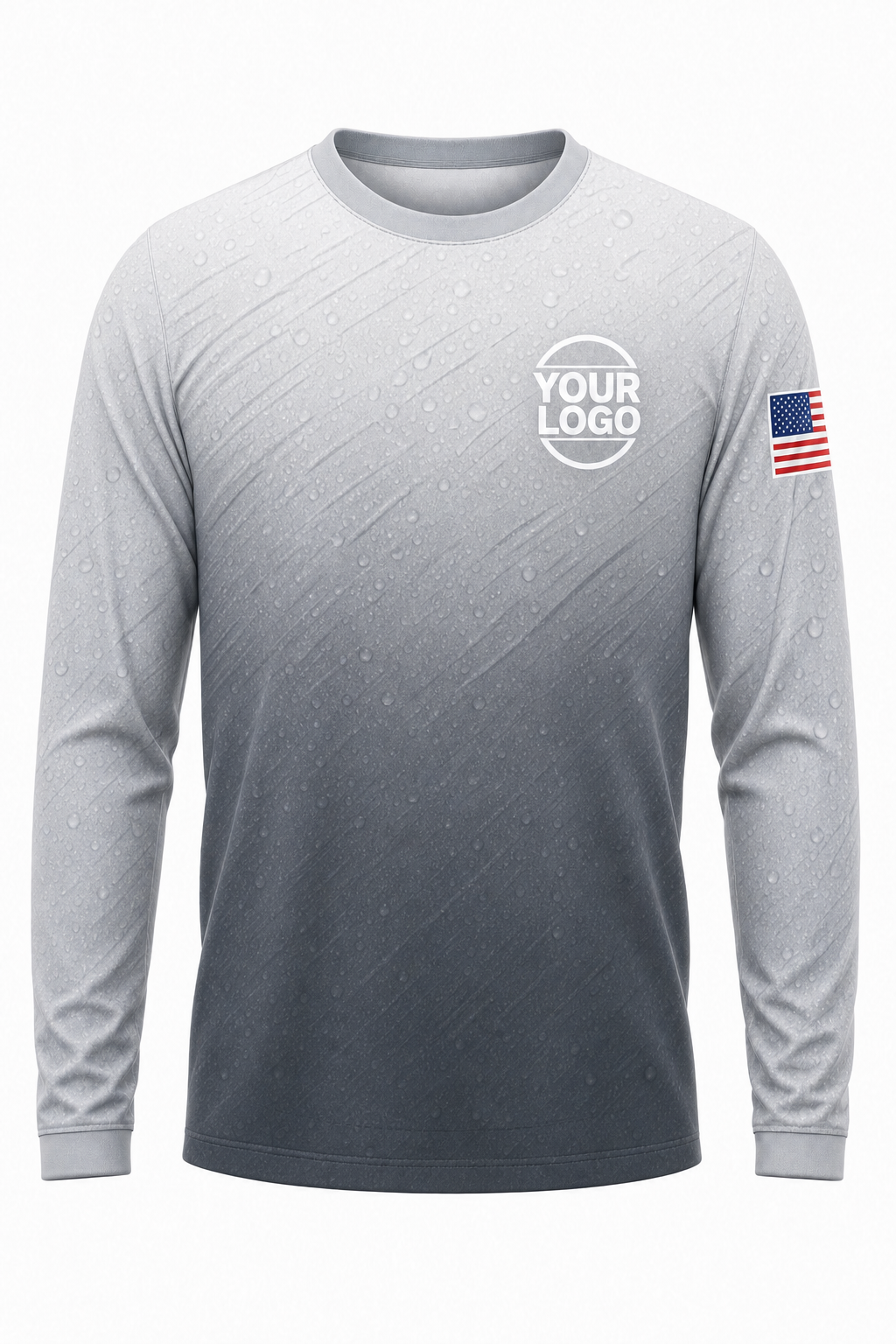
Sun protection matters just as much and gets ignored more. A thin, worn cotton shirt lets a surprising amount of UV through — you can burn through a shirt on a long mowing day. A UPF 50+ fabric blocks the bulk of that exposure, which is why a lightweight long sleeve is often the smarter choice for mowing crews than a tank top and sunscreen. A wicking long sleeve with UPF 50+ keeps forearms cooler than bare skin baking in direct sun, and there's no reapplying anything at lunch. Every shirt in the lawn care collection is built on this fabric — lightweight, moisture-wicking polyester rated UPF 50+.


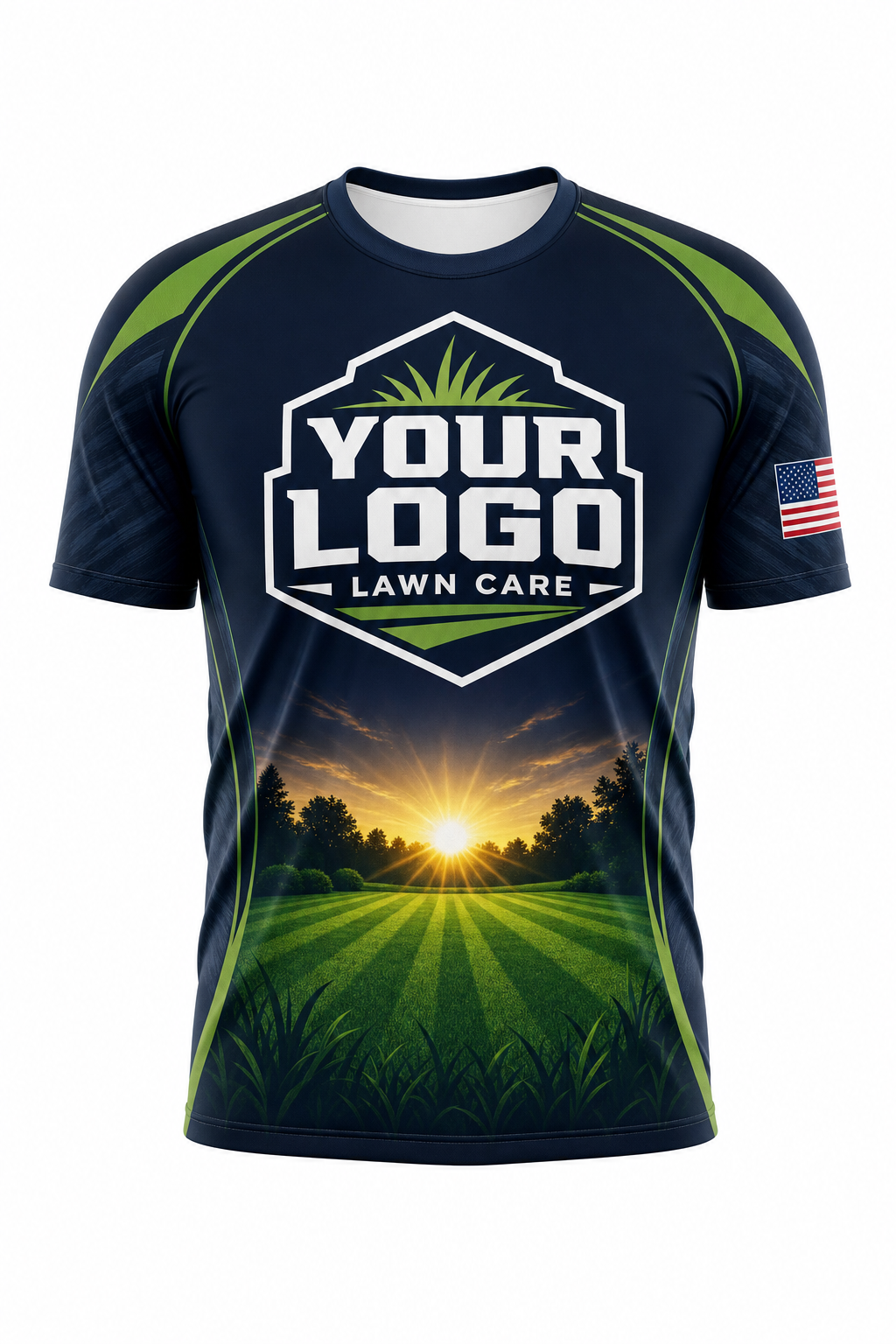
Same design, same UPF 50+ wicking polyester, whichever garment the crew works in.
Grass Stains, Fertilizer, and the Wash Cycle
Grass stains ruin cotton because chlorophyll bonds to natural fiber and doesn't want to let go. Polyester doesn't absorb stains the same way — most of what a route throws at a shirt (grass, mud, fertilizer dust, two-cycle mix) washes out with a normal cycle.
The print is the other half of the durability question. On these shirts the design is applied by full-garment dye-sublimation, which means the ink is bonded into the polyester fiber itself rather than sitting on top of it. The practical consequences for a lawn crew:
- It is designed to resist cracking, peels, or fades. There is no plastic layer to break down over a season of sweat and sun.
- It's chemical and bleach resistant. If a shirt catches herbicide overspray or needs a hot wash with bleach after a rough week, the print doesn't care. You can wash these shirts the way work clothes actually need to be washed.
- Care is simple. Machine wash, hang or tumble dry — polyester dries fast either way. Skip fabric softener, which coats wicking fibers and dulls their ability to move sweat. That's it. No inside-out washing, no babying the logo.
Dye-Sublimation vs. Screen Print vs. Embroidery
Most crews shopping for uniforms are comparing three decoration methods. They behave very differently after fifty washes, which is the timeframe that matters when a shirt gets worn two or three times a week.
| Factor | Dye-sublimation | Screen print | Embroidery |
|---|---|---|---|
| How it works | Ink is dyed into the polyester fiber | Ink layer sits on top of the fabric | Thread stitched through the fabric |
| Coverage | Entire garment, edge to edge, any number of colors | Limited print zones; cost rises with each color | Small areas only — chest logos, not backs |
| Feel | No added weight or texture; shirt stays breathable | Stiff patch where the ink sits; can trap heat | Heavy, with a backing patch against the skin |
| After heavy washing | Designed to resist cracking, peels, or fades; bleach resistant | Cracks and peels over time, especially with hot washes | Thread holds up, but fabric around dense stitching can pucker |
| Best use on a route | Daily-wear crew shirts that get washed hard | Occasional-wear event tees | Supervisor polos where a small stitched logo is enough |
Embroidery still has a place — a stitched left-chest logo on a polo looks sharp at an estimate. But for the shirts your crew sweats in every day, sublimation is the only method where the branding survives as long as the shirt does, and the only one that lets you print big, readable text across the whole back without adding a stiff, hot ink panel.
The Back of the Shirt Is a Moving Yard Sign — Use It
Your crew spends the day in front yards on streets full of homeowners who need lawn service. A well-laid-out shirt does quiet advertising for every hour of it. A layout that works:
- Front left chest: logo and company name. Clean and small — this is the version people see up close.
- Back, top third: company name in large type, readable from across the street. This is the money placement; don't shrink it to fit a slogan.
- Back, below the name: phone number in big numerals, then a short services line — "Mowing • Cleanups • Irrigation" beats a paragraph.
- Sleeve: website or town name if you want it, or leave it clean.

You don't have to design any of this yourself. Send your logo (or even just your company name, phone, and services list) and TCV's designers build the layout for free, with a digital mockup delivered within 24 hours. Revisions are unlimited, and nothing goes to production until you approve the proof — so if the phone number needs to be bigger, say so and get a new mockup.
Sizing for People Who Bend, Reach, and Load Trailers
These shirts are cut in a US athletic fit, and they run fitted — slimmer through the torso than a boxy standard tee. That's worth knowing before you order for a whole crew. Two practical rules:
- If a crew member is between sizes, or simply prefers room to move when lifting mowers and reaching overhead, order one size up.
- Don't guess. Take everyone's best-fitting shirt, lay it flat, measure chest and length, and compare against the size chart. Five minutes with a tape measure saves a round of exchanges.
Sizes run S through 5XL, so one order covers the whole roster, and the sizing is consistent across garment types — a crew member who wears XL in the t-shirt wears XL in the hoodie, which makes reorders and new-hire orders painless.
Building the Kit and Placing the Order
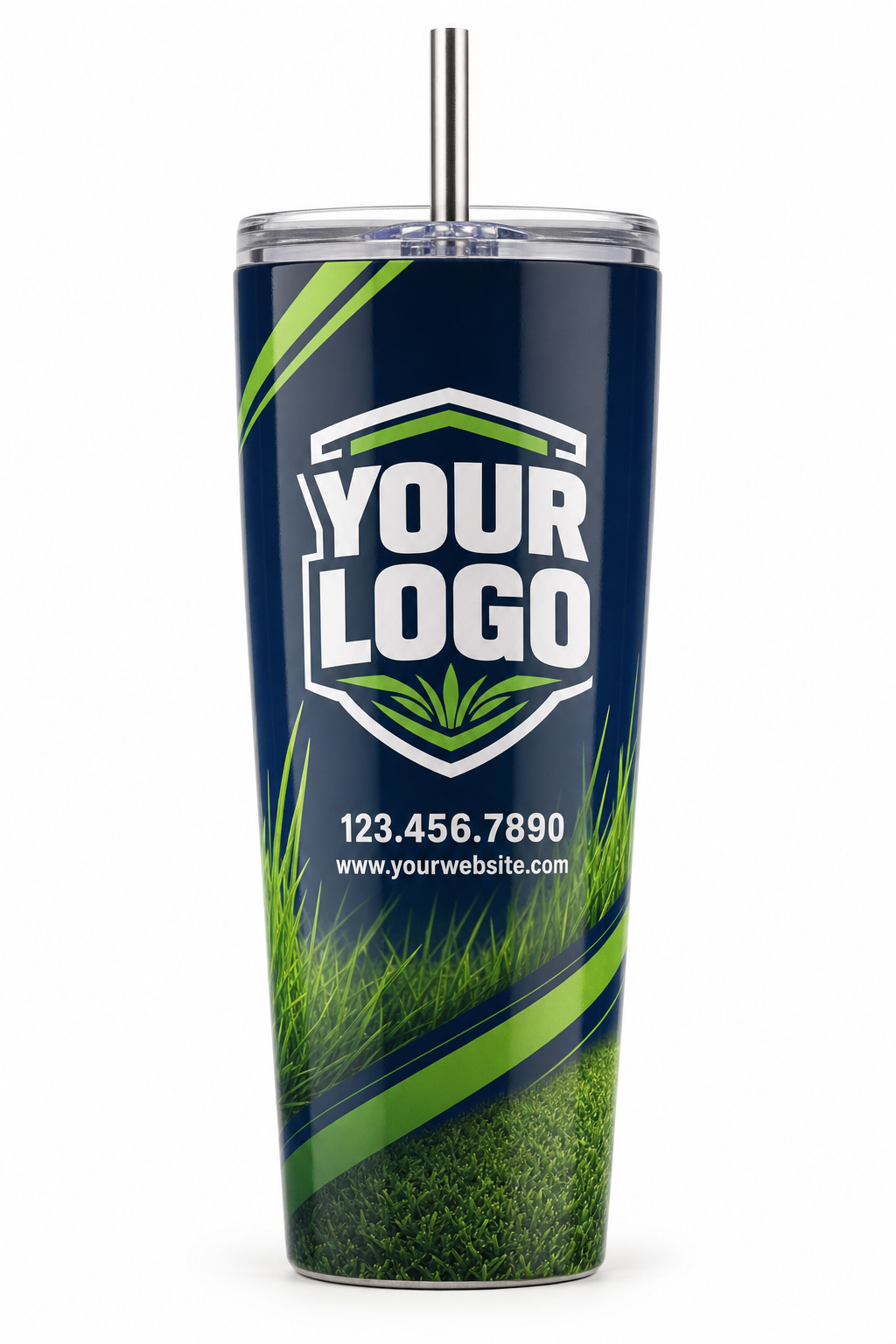
Mowing season doesn't end when summer does, and the uniform shouldn't either. A sensible kit for a small operation, all in one design: t-shirts and tank tops for the heart of the season, long sleeves for sun protection and the shoulder weeks, polos for whoever runs estimates, and sweatshirts, hoodies, or zip hoodies for fall cleanups and frost-morning starts. Matching 20 oz and 40 oz insulated tumblers round it out — a crew that drinks water in July is a crew that finishes the route. Every garment type carries your same design in the full catalog.
There is no minimum order, so you can buy one shirt, test it on a real workday, then order for the crew. The process, start to finish:
- Pick your garments and sizes.
- Send your logo — or just your company name, phone number, and services if you don't have one. Design work is free.
- Get a free digital mockup within 24 hours. Request changes until it's right; revisions are unlimited.
- Approve the proof. Production only starts after your approval.
- Production takes 3–5 business days, delivery 7–15 days. Plan uniform orders two to three weeks ahead of when you need them on backs.
Crew discounts apply automatically at checkout: 5% off at 5+ items, 10% off at 10+, and 15% off at 15+. Orders of 5 or more items also ship free to any country; below that, standard shipping is $5.99 to the US, Canada, UK, Australia, and New Zealand, and $9.99 flat across the EU. Everything is made to order, so returns are limited to defects — anything that arrives flawed gets a remake or refund within 14 days. The step-by-step details live on the how-to-order page.
Popular Lawn Care Designs


Frequently Asked Questions
Is there a minimum order for crew uniforms?
No. You can order a single shirt to test fabric and fit before committing to a crew set. Discounts start automatically at 5 items (5% off), and orders of 5+ items ship free worldwide.
Will bleach or lawn chemicals ruin the printed logo?
No. Dye-sublimation bonds the ink into the polyester fiber, and the print is chemical and bleach resistant. Hot washes, bleach, fertilizer dust, and herbicide overspray won't crack, peel, or fade it.
Do the shirts run true to size?
They're cut in a US athletic fit that runs fitted. If you're between sizes or want a looser working fit, size up. Sizes run S–5XL — measure a shirt that fits well and compare it against the size chart before ordering for the whole crew.
How fast can my crew be wearing them?
You'll have a free digital mockup within 24 hours of sending your logo. After you approve it, production takes 3–5 business days and delivery takes 7–15 days, so most crews are suited up in about two to three weeks.
Ready to put your company name on the route? Start with a custom uniform in your design — send your logo, get a free mockup within 24 hours, and pay nothing for design work or revisions. No minimum order, crew discounts from 5 items, and a print that will still look sharp when the mower needs new blades. Browse the lawn care collection to get started.